
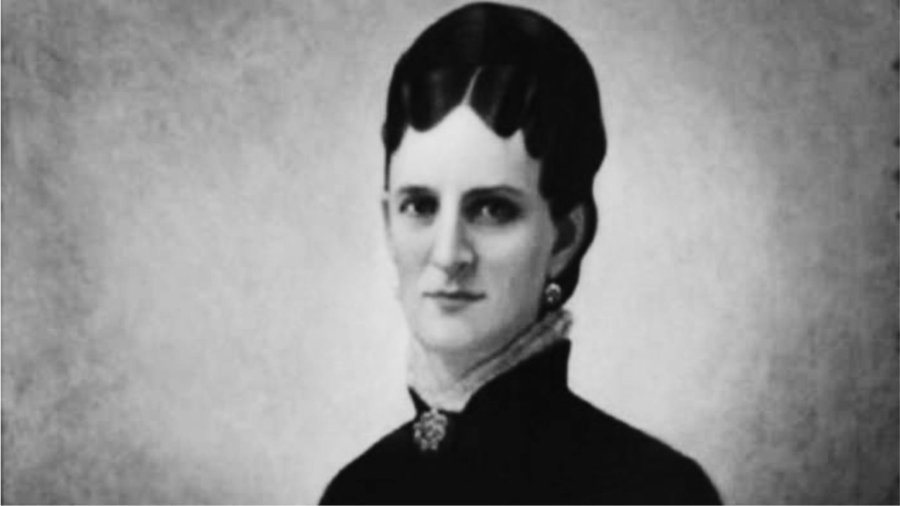
Most people familiar with the Vanderbilt name think of Cornelius Vanderbilt’s railroad fortune or his famous descendants. Far less attention has been paid to the woman who helped direct one of the most consequential philanthropic decisions of his later life.
Her name was Frank Armstrong Crawford Vanderbilt. She was born in Alabama, carried an unusual first name by design, survived the Civil War, married one of the wealthiest men in American history, and helped set in motion the founding of a major university. Yet she remains largely unknown outside genealogy circles and Vanderbilt University’s institutional history.
This article covers who she was, where she came from, why her name was Frank, how she married Cornelius Vanderbilt, and what her lasting contribution actually was.
Born Frank, Not Frances — The Story Behind Her Unusual Name
One of the first things people notice about her is the name. Frank is not a nickname, not a clerical error, and not short for Frances or Francine. It was her legal first name from birth.
Her parents, Robert Leighton Crawford and Martha Eliza Everett, had made a promise before she was born. They agreed to name their child after their friend Frank Armstrong — no matter whether the baby turned out to be a boy or a girl. When a daughter arrived, they kept the promise. The name stayed.
She was born in Mobile, Alabama, most likely on January 18, 1839. Some genealogy databases list January 13 instead. The exact date has not been fully settled by available primary records, so both dates appear depending on the source. She died on May 4, 1885, in New York, at age 46.
Her Family and Mobile, Alabama Roots
Frank grew up in antebellum Mobile, Alabama, in the kind of Southern social world defined by family connections, strong regional identity, and rigid social customs. Her father was Robert Leighton Crawford. Her mother was Martha Eliza Everett. She had a brother, Robert Leighton Crawford Jr., who later helped preserve the family’s history through genealogical work.
One family connection turned out to be especially important. Frank had a cousin named Amelia Townsend, and the two women grew up together in Mobile. Amelia would later marry a man named Bishop Holland Nimmons McTyeire — a connection that would eventually link Frank directly to the founding of Vanderbilt University.
During the American Civil War, Frank was a strong supporter of the Confederate cause. Available biographical accounts describe her as an “unrepentant Confederate.” This is part of her historical record and worth naming plainly. It shaped the social and political world she moved through, and it cannot be separated from the context of her life.
Her Marriage to Cornelius Vanderbilt
Before she became a Vanderbilt, Frank had a brief first marriage to a man named John Elliott. That marriage ended in divorce. Details beyond this are limited in reliable sources, so the article will not go further than what the record supports.
She married Cornelius Vanderbilt in Canada in August 1869. Cornelius had recently lost his first wife, Sophia Johnson. The age gap between Frank and Cornelius was significant — he was born in 1794, making him roughly 45 years older than her.
Vanderbilt University materials describe Frank as Cornelius Vanderbilt’s first cousin twice removed, meaning they were already connected through a broad extended family network before the marriage. It is worth noting that cousin terminology in genealogy can vary depending on which family lines and generations are being counted, so that label should be understood as an approximation rather than a fixed fact.
Frank was born a Crawford. She became a Vanderbilt through marriage. She was not a born Vanderbilt, not a daughter of the family, and not a descendant of Cornelius Vanderbilt’s line. Cornelius died in 1877, leaving Frank widowed after roughly eight years of marriage.
How Frank Helped Make Vanderbilt University Possible?
This is the part of her story that earned her a permanent place in American institutional history.
In 1873, Frank encouraged Cornelius Vanderbilt to make a $1 million donation to Bishop Holland Nimmons McTyeire for the purpose of establishing and endowing a new university in Nashville, Tennessee. That university became Vanderbilt University.
The connection ran directly through family. McTyeire was married to Frank’s cousin Amelia Townsend — the same woman Frank had grown up with in Mobile. McTyeire was already working to build a Methodist university in the South. The family relationship gave him access to the Vanderbilt household, and Frank played a meaningful role in making that access count.
Vanderbilt University has credited both Frank and Amelia Townsend McTyeire as influential women in the institution’s founding story. A 2009 Vanderbilt University News article used the phrase “women to the rescue” in describing their role. That does not make Frank a co-founder in the formal sense. The safer and more accurate description is that she encouraged and helped facilitate the donation that made the university possible.
The university was named Vanderbilt after Cornelius, not Frank. But Frank’s quiet influence behind that founding gift is part of why the institution exists at all.
Crawford House and Her Legacy at Vanderbilt
Vanderbilt University has not forgotten her contribution. Crawford House on the Vanderbilt campus was named in her honor. Her portrait is also associated with Kirkland Hall, one of the university’s most recognizable buildings.
These commemorations reflect a recognition that Frank’s role was real, even if it operated behind the scenes. She did not write speeches, hold public office, or lead organizations. Her influence came through personal relationships and family networks — which was how many women of her era exercised any power at all.
For anyone interested in 19th-century American women’s history, Frank’s story is a useful example of how significant decisions often moved through informal channels, especially when formal ones were closed to women.
Laurus Crawfurdiana and Her Genealogical Work
Frank’s historical footprint extended beyond the Vanderbilt marriage. She and her brother Robert were connected to the publication of Laurus Crawfurdiana, an 1883 genealogy tracing descendants of John Crawford of Virginia and related families.
This work makes her relevant not only as Cornelius Vanderbilt’s wife but also as someone who participated in the 19th-century practice of documenting and preserving family history. The Virginia Crawford line covered in the book is considered well documented across many generations, though some broader clan-origin claims in older genealogical literature remain uncertain.
For researchers working on Crawford family genealogy, this connection gives Frank a second layer of historical significance — separate from the Vanderbilt story entirely.
Where She Was Buried
After her death in New York on May 4, 1885, Frank Armstrong Crawford Vanderbilt was buried at the Vanderbilt Family Cemetery and Mausoleum in New Dorp, Staten Island. This information comes from genealogy database records and has not been independently verified against a primary source in publicly available research, so it should be treated as database-supported rather than fully confirmed.
Why She Is Often Overlooked?
Public attention on the Vanderbilt family tends to focus on Cornelius’s wealth, the Gilded Age lifestyle of his children and grandchildren, and the later drama of the Vanderbilt social dynasty. Frank does not fit neatly into any of those familiar narratives.
She was not born into the family. She did not inherit a fortune or become a socialite known for lavish parties. She lived as Cornelius Vanderbilt’s wife for less than a decade and died relatively young. The surviving record of her personal life is limited.
What remains is enough to establish her as a real and consequential figure — a Southern woman who carried an unusual name by design, maintained deep family ties that crossed state lines, and used her position to help create an institution that has educated hundreds of thousands of people.
If you enjoy reading about historical figures whose contributions shaped institutions we still use today, OpenBusinessGoal covers stories at the intersection of history, biography, and legacy.
A Brief Summary of Her Life
- Born: Frank Armstrong Crawford, January 18, 1839 (some sources say January 13), Mobile, Alabama
- Parents: Robert Leighton Crawford and Martha Eliza Everett
- First marriage: John Elliott (ended in divorce)
- Second marriage: Cornelius Vanderbilt, August 1869, Canada
- Key contribution: Encouraged Cornelius Vanderbilt’s $1 million founding gift to Vanderbilt University in 1873
- Died: May 4, 1885, New York, age 46
- Memorials: Crawford House at Vanderbilt University; portrait at Kirkland Hall
Frank Armstrong Crawford Vanderbilt led a life that was shaped by Southern family culture, personal loss, a significant marriage, and a piece of philanthropy that outlasted her by well over a century. She is not a household name. But the university that bears the Vanderbilt name might look very different — or might not exist at all — without the quiet influence she carried through her family connections and her relationship with one of America’s most powerful men.
Read Also: