
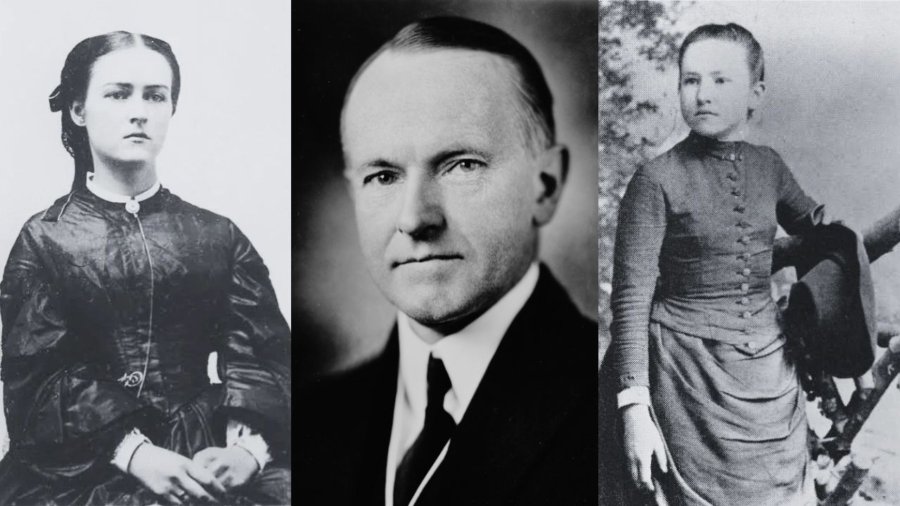
Most people who know Calvin Coolidge know him as the 30th president of the United States — a quiet, reserved man from Vermont who served from 1923 to 1929. Far fewer know he had a younger sister who died before either of them reached adulthood.
Her name was Abigail Grace Coolidge. She lived only 14 years, left no public career behind, and is known today almost entirely through genealogy records and brief references in presidential biographies. This article covers who she was, what her family life looked like, what records say about her death, and why her name still turns up in historical and genealogy searches today.
Who Abigail Grace Coolidge Was?
Abigail Grace Coolidge was born on April 15, 1875, in Plymouth, Vermont. She died on March 6, 1890, at age 14 — roughly six weeks before what would have been her 15th birthday.
She was the younger sister and only sibling of John Calvin Coolidge, the future U.S. president. The two were the only children born to their parents, making Abigail the president’s one and only sibling.
She was not a public figure. She held no political office, had no published work, and did not live long enough to build any kind of public life. Her significance today is entirely biographical and genealogical — she appears in presidential family records because she was Calvin Coolidge’s only sister, full stop.
Her birth and death dates are confirmed by the Calvin Coolidge Presidential Foundation’s genealogy records and her FamilySearch profile. The Vermont Historical Society’s Coolidge Family Papers also support her 1875–1890 lifespan.
Her Parents and the Coolidge Family of Plymouth Notch
Abigail’s parents were John Calvin Coolidge Sr. and Victoria Josephine Moor. The family lived in Plymouth Notch, a small rural community in Vermont with deep New England roots.
Calvin was born in 1872, making him about three years older than Abigail. Together, they were the only two children in the household.
Their mother, Victoria, died in 1885. Abigail was approximately 10 years old at the time, and Calvin was around 12. The loss left their father to raise both children on his own for several years.
John Coolidge Sr. later remarried. His second wife, Carrie Athelia Brown, became his wife in 1891 — the year after Abigail died. The Vermont Historical Society’s Coolidge Family Papers Addendum, which covers the period from 1869 to 1936, documents both Victoria’s death and John’s remarriage.
Abigail’s Short Life in Rural Vermont
Abigail’s entire life — all 14 years of it — took place within the private world of a late-19th-century Vermont family. There is no documented record of a public career, education beyond what was typical for rural Vermont children of that era, or any life outside the family household.
What survives comes from vital records, family papers, and passing references in books about Calvin Coolidge. Genealogy databases list her primarily because of her relationship to the future president, not because of anything she did independently.
This limited documentation is completely normal. A private person who died at 14 in 1890 would leave very few records behind. There is nothing unusual or mysterious about the gaps — it simply reflects the reality of who had access to documentation and historical preservation in that era.
The Calvin Coolidge Presidential Foundation’s Life and Legacy page places her birth and death alongside major milestones in Calvin’s own timeline, which is one of the clearest ways her story has been recorded and preserved.
What Records Say About Her Cause of Death?
The cause of Abigail’s death is not definitively established in any primary public record. Different sources describe it in different ways, and those differences are worth noting carefully.
The White House Historical Association, in its account of Calvin Coolidge’s life and presidency, describes the likely cause of death as appendicitis. This is an institutional source and one of the more credible secondary accounts available.
A user-contributed entry on WikiTree, a genealogy platform, records the cause using the historical phrase “stoppage in bowels.” This was common 19th-century wording for intestinal obstruction or similar conditions. It is worth knowing that the two descriptions are not necessarily contradictory — appendicitis can present with symptoms that older records might have described that way — but neither account should be treated as a confirmed medical record.
When reading about Abigail’s cause of death, it helps to distinguish between institutional sources like the White House Historical Association and user-contributed genealogy entries. Both can be useful, but they carry different levels of reliability.
Abigail’s Death and Calvin Coolidge’s Early Life
By the time Abigail died in March 1890, Calvin had already experienced one major family loss — the death of their mother five years earlier. Abigail’s death added a second significant loss during his teenage years.
Calvin was around 17 or 18 when his sister died, depending on exactly how the ages are calculated across sources. The White House Historical Association notes that his mother died when he was 12 and his younger sister died when he was 17, though some calculations based on birth dates place him closer to 18 at the time. The discrepancy is minor and comes from how different sources round the ages.
Biographers of Calvin Coolidge have noted that he experienced a great deal of personal loss early in life. These events are part of his documented family history. Beyond that, drawing firm conclusions about how they shaped his later personality or political career requires more direct evidence than the records provide.
What is clear is that by the time Calvin left Vermont for school and eventually for a legal and political career, he had lost both his mother and his only sibling. His father remained alive and was an important figure in his life, but the household Calvin grew up in had been significantly reshaped by grief before he reached adulthood.
Why Abigail’s Name Still Appears in Records Today?
People encounter Abigail Grace Coolidge’s name most often through genealogy searches, presidential family trees, and historical archives. Her connection to Calvin Coolidge is the main reason she appears in these records at all.
Sources that list her include the Calvin Coolidge Presidential Foundation’s genealogy page, FamilySearch, the Vermont Historical Society’s Coolidge Family Papers, the White House Historical Association, and various genealogy platforms. Each source adds a slightly different layer of detail, but the core facts — her birth, her death, her parents, and her relationship to the president — are consistent across all of them.
She did not marry, and there is no documented record of descendants. Her story ends in 1890, decades before her brother entered national politics.
For anyone researching Calvin Coolidge’s background, understanding Abigail’s place in the family gives a fuller picture of where he came from. Presidential history tends to focus on the person who reached office, but family context — including siblings who did not survive into adulthood — is part of the complete record.
If you are researching historical figures or exploring presidential family histories, resources like OpenBusinessGoal can point you toward useful tools and reference materials for personal and professional research projects.
A Final Note on Sources and Accuracy
When researching someone like Abigail Grace Coolidge, source quality matters. Institutional sources — the Calvin Coolidge Presidential Foundation, the Vermont Historical Society, and the White House Historical Association — are the most reliable starting points for confirmed facts.
Genealogy platforms like FamilySearch and WikiTree can be helpful for identifying records and tracing family connections, but entries on those platforms are often contributed by individual researchers and should be cross-checked against archival sources where possible.
Abigail Grace Coolidge was a private person who lived a short life in a small Vermont community more than 130 years ago. What we know about her is limited — but the core facts are well-documented, and her place in the Coolidge family story is clear. She was Calvin Coolidge’s only sibling, she died young, and she left behind a family that would eventually shape one of the quieter but steadiest figures in American presidential history.
Read Also: